dev_moon-shadow-pic-logger
ESP32-CAM periodic low-light photo logger — firmware & host logger devlog
Periodic low-light photography using an AI-Thinker ESP32-CAM-MB. Firmware (Rust / ESP-IDF) wakes on an MQTT trigger, captures a JPEG, and HTTP POSTs it to a host logger. The host is a Rust binary with a terminal TUI running on a local server, managing the capture schedule and receiving photos over a plain TCP HTTP server.
┌──────────────────┐    MQTT senddata    ┌─────────────────────┐
│   logger TUI     │ ─────────────────▶  │  ESP32-CAM-MB       │
│   (debserver)    │                     │  OV2640 / 8MB PSRAM │
│   axum :8765     │ ◀───────────────── │  Rust / ESP-IDF     │
└──────────────────┘    HTTP POST JPEG   └─────────────────────┘
         │
         ▼
  ~/pic_logs/2026-06-27/
    20260627T020015Z_000.jpg
    20260627T021015Z_001.jpg …
Firmware
Standard ESP Rust toolchain (channel = "esp"), ESP-IDF v5.3, xtensa-esp32-espidf target. Credentials live in a dedicated 4 KB config partition at 0x3F0000 — top of flash, safe from app growth — as a magic-header + length-prefixed JSON blob.
Two-Thread MQTT
EspMqttClient deadlocks if subscribe() is called from the same thread as connection.next() — the ESP-IDF MQTT library holds an internal API lock during TCP receive. Fix: a background thread pumps the event loop over a channel to the main thread.
enum Ev {
    Connected,
    Received { topic: String, data: Vec<u8> },
    Disconnected,
    Fatal,
}

// Background thread — event pump
std::thread::Builder::new().stack_size(16384).spawn(move || {
    loop {
        match connection.next() {
            Ok(event) => {
                let ev = match event.payload() {
                    EventPayload::Connected(_)   => Some(Ev::Connected),
                    EventPayload::Disconnected   => Some(Ev::Disconnected),
                    EventPayload::Error(_)       => Some(Ev::Fatal),
                    EventPayload::Received { topic: Some(t), data, .. } =>
                        Some(Ev::Received { topic: t.to_string(), data: data.to_vec() }),
                    _ => None,
                };
                // event dropped here — before channel send
                if let Some(ev) = ev { let _ = tx.send(ev); }
            }
            Err(_) => { let _ = tx.send(Ev::Fatal); break; }
        }
    }
})?;
The event is decoded into owned heap data (String/Vec<u8>) and dropped before the channel send — the ESP-IDF event carries an internal buffer reference that cannot outlive the event callback, so the copy must happen inside the match.
Camera on Core 1
The OV2640 DMA runs an ISR that fires continuously. On Core 0 it preempts the WiFi task’s beacon handler, causing beacon timeouts that disconnect MQTT sessions mid-capture. Fix is one line in sdkconfig.defaults:
CONFIG_CAMERA_CORE1=y
Camera DMA stays on Core 1; WiFi stays on Core 0. MQTT sessions stay alive.
Deferred Camera Init
Camera DMA flooding the ISR event queue during the TCP handshake caused select() timeouts on MQTT connect. Camera is now initialized only after the first Ev::Connected fires, and stays initialized across reconnects:
let mut cam_ready = false;
// …
Ev::Connected => {
    if !*cam_ready {
        camera::init(*rt_framesize, *rt_quality)?;
        *cam_ready = true;
    }
    client.subscribe(&senddata_topic, QoS::AtMostOnce)?;
    // …
}
GRAB_LATEST — Camera DMA Mode
With the default CAMERA_GRAB_WHEN_EMPTY, the DMA ring has one slot. If idle JPEG frames overflow it, the DMA fills permanently — every subsequent fb_get times out and the camera is dead until reboot. Fix: two framebuffers + GRAB_LATEST, which overwrites the oldest buffer continuously so the DMA never stalls.
fn jpeg_config(framesize: u8, quality: u8) -> CameraConfig {
    make_config(framesize, quality, PIXFORMAT_JPEG, 2, CAMERA_GRAB_LATEST)
}
PWDN Float After Deinit
After esp_camera_deinit(), the driver releases GPIO32 (PWDN) to high-Z. The AI-Thinker board has no external pullup, so the OV2640 never actually power-cycles — reinit reads stale mode registers and returns 0x106 (ESP_ERR_NOT_SUPPORTED). Fix: drive PWDN HIGH explicitly after every deinit, then wait 1000 ms before reinit.
fn hold_pwdn_high() {
    unsafe {
        let _ = esp_idf_sys::gpio_set_direction(32, gpio_mode_t_GPIO_MODE_OUTPUT);
        let _ = esp_idf_sys::gpio_set_level(32, 1);
    }
}
Flash LED — Bypassed
The white flash LED (GPIO4) caused a boot loop during early development: a flash write bug left the config partition blank after erase, and every subsequent boot panicked on missing magic bytes. The underlying bug is fixed (stack-allocated DMA-safe write buffer), but flash is not needed for nighttime photography and has been disabled entirely. GPIO4 stays LOW.
Logger
moon_temp_pic_logger runs on the local server. Two concurrent tasks: an MQTT publisher on a configurable schedule, and an axum HTTP server (port 8765) that receives JPEGs and saves them to a date-organized directory. Control is via a ratatui terminal TUI.
Schedule Tab
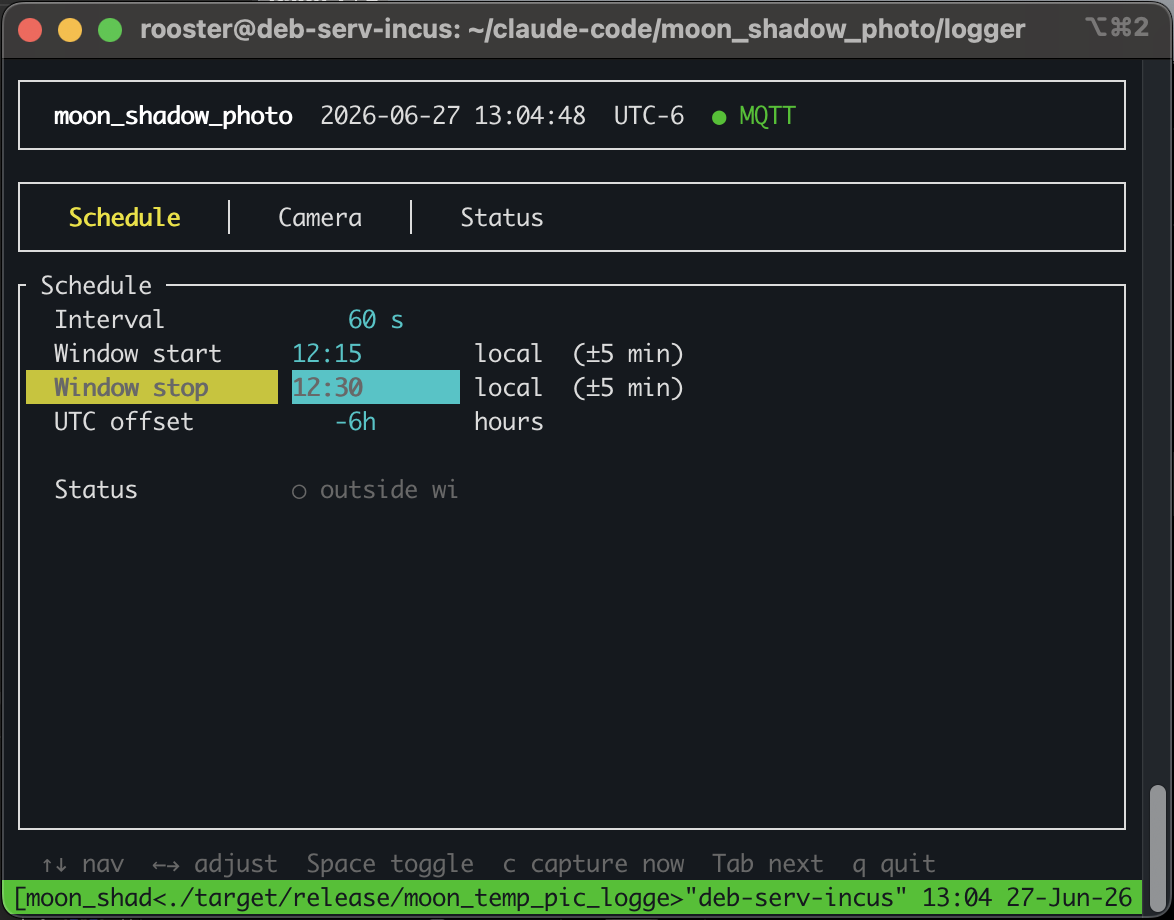
Sets the capture window and interval. Window start / stop are local-time boundaries; the overnight wrap (e.g. 20:00–06:00) is handled automatically. Captures jitter ±5 min to avoid the same exact timestamp every night. Status shows ○ outside window during the day; ● ACTIVE — next capture in Ns when live.
Camera Tab
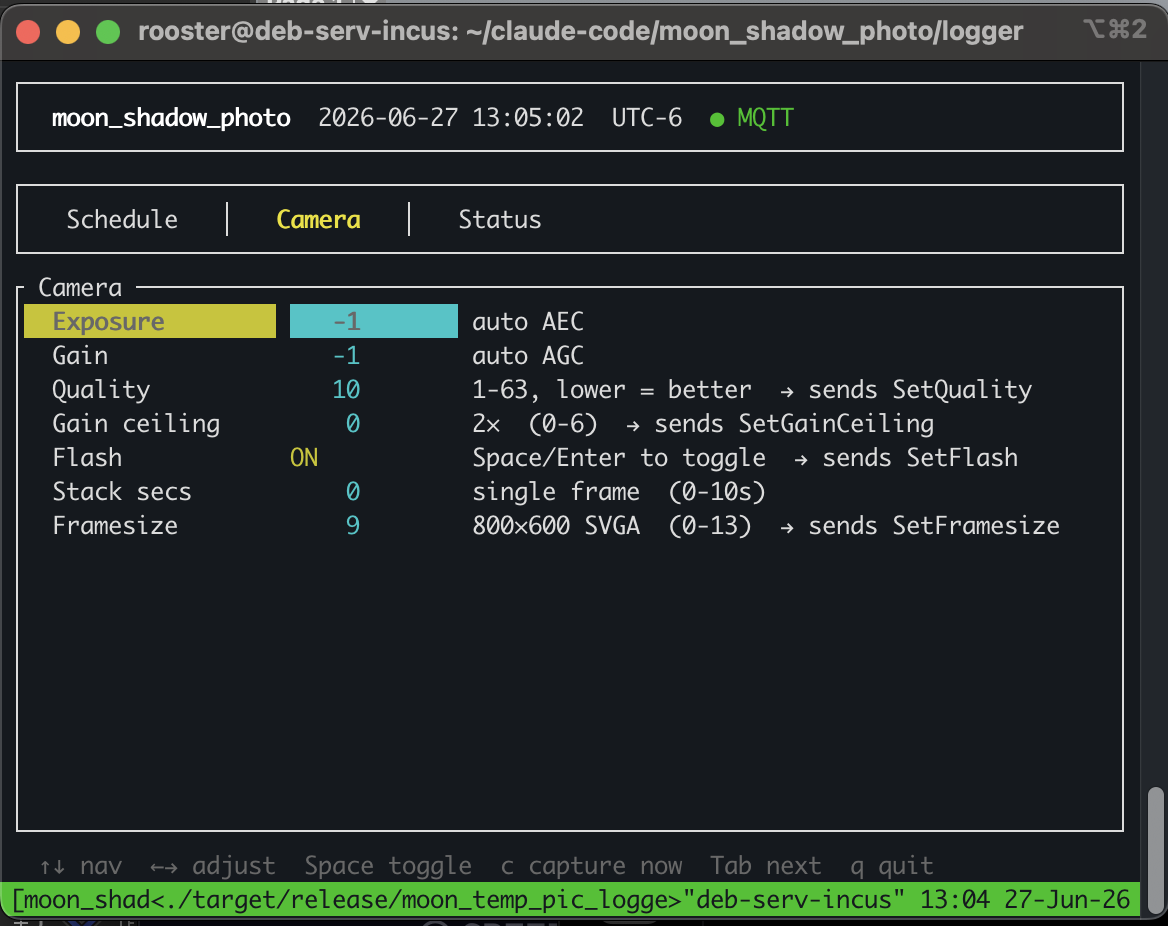
Controls per-capture sensor settings sent in the senddata MQTT payload, and persistent device config pushed via cmd messages. Changes on the Camera tab are batched — pressing s sends all camera settings at once rather than one MQTT publish per keypress.
| Field | Sent as |
|---|---|
| Exposure, Gain, Stack secs | senddata payload (per-capture) |
| Quality, Gain ceiling, Framesize | cmd MQTT (persisted in firmware runtime state) |
Low Light Settings
The OV2640 tops out at ~850 ms exposure (1200 AEC lines at SVGA). Single-frame results are good for moonlit scenes. Recommended starting points:
| Scene | Exposure | Gain | Gain ceiling | Notes |
|---|---|---|---|---|
| Bright moonlight | -1 (auto) |
-1 (auto) |
0 (2×) |
Let AEC/AGC find the balance |
| Moderate moonlight | 800 |
10 |
3 (16×) |
~560 ms, ~ISO 1000 equiv |
| Faint moonlight | 1200 |
20 |
6 (128×) |
Max exposure, high gain, noisy |
| Full dark | 1200 |
30 |
6 (128×) |
Max everything — usable but noisy |
Quality 10 (default) gives good detail at SVGA 800×600. Stack secs should be left at 0.
Frame Stacking
The firmware includes a frame-averaging stack — deinit, grayscale reinit, accumulate N frames, encode JPEG — but it is not expected to be used in normal operation. The reinit cycle adds ~3 seconds of overhead, and the software JPEG encoder path produces different color characteristics than the OV2640’s hardware encoder. If longer effective exposure becomes a requirement it can be revisited, but more work would be needed to make it reliable.
Source
firmware/src/
  main.rs     — WiFi, SNTP, two-thread MQTT loop, capture orchestration
  config.rs   — Flash-backed JSON config at 0x3F0000
  camera.rs   — Manual esp32-camera FFI (bindgen fails on macOS vs esp_camera.h)
  types.rs    — MQTT payload structs

logger/src/
  main.rs     — ratatui TUI, MQTT publisher, axum HTTP server, file save
  config.rs   — TOML config loader
Firmware: git@github.com:rooster-ninja/moon_shadow_photo.git
Logger: git@github.com:rooster-ninja/moon_shadow_pic_logger.git